FUNCTION STORE / LOOMS

THE LOOMS

Hold one chord and every track plays from it

The Looms are plugins that play the notes you hold. Each one replays them in its own way, as pulses, picked notes, grains, ringing strings or loops, and passes what it plays to the next Loom on another track, with no MIDI routing in the host. CompLoom gives them a row of chords to start from and a scale to keep to, and GuitLoom lets a guitar play them.

This chain is running in your browser. The keys at the top are held, and every row takes the notes of the row above it. Change the chord on the keys (or with A to J and W E T Y U), and click a Loom's card to unhook it, so the next one takes its notes straight from the one before.

Listen plays all four Looms at once, each through a plain synth of its own, and an unhooked Loom goes quiet. Each row runs one simple setting of its Loom. The plugins have many more.

WHAT EACH LOOM DOES

Each Loom does one thing to the notes it is given. CompLoom writes the chords and GuitLoom hears them from a guitar. PenduLoom times them, SHLoom picks from them, and GranuLoom, ResoLoom and HeirLoom turn them into sound.

Writes the chords

COMPLOOM

A row of chord cards that the other Looms play from.

A card is five notes counted from a key: a bass, three notes of the chord and a top. CompLoom holds the card in use and moves to the next with the host's clock, the white keys or automation. It comes with 49 progressions. Every note it sends says which slot of the card it is, so one Loom can take the whole card, another only the bass and a third only the top. It also sets a scale, which the other Looms can lock their notes to.

Takes
this track's keys, to pick or hold a card
Offers
the card in use, slot by slot
CompLoom's window: a row of chord cards above the five slots of the picked card

Hears a guitar as notes

GUITLOOM

Play a guitar and every Loom plays along.

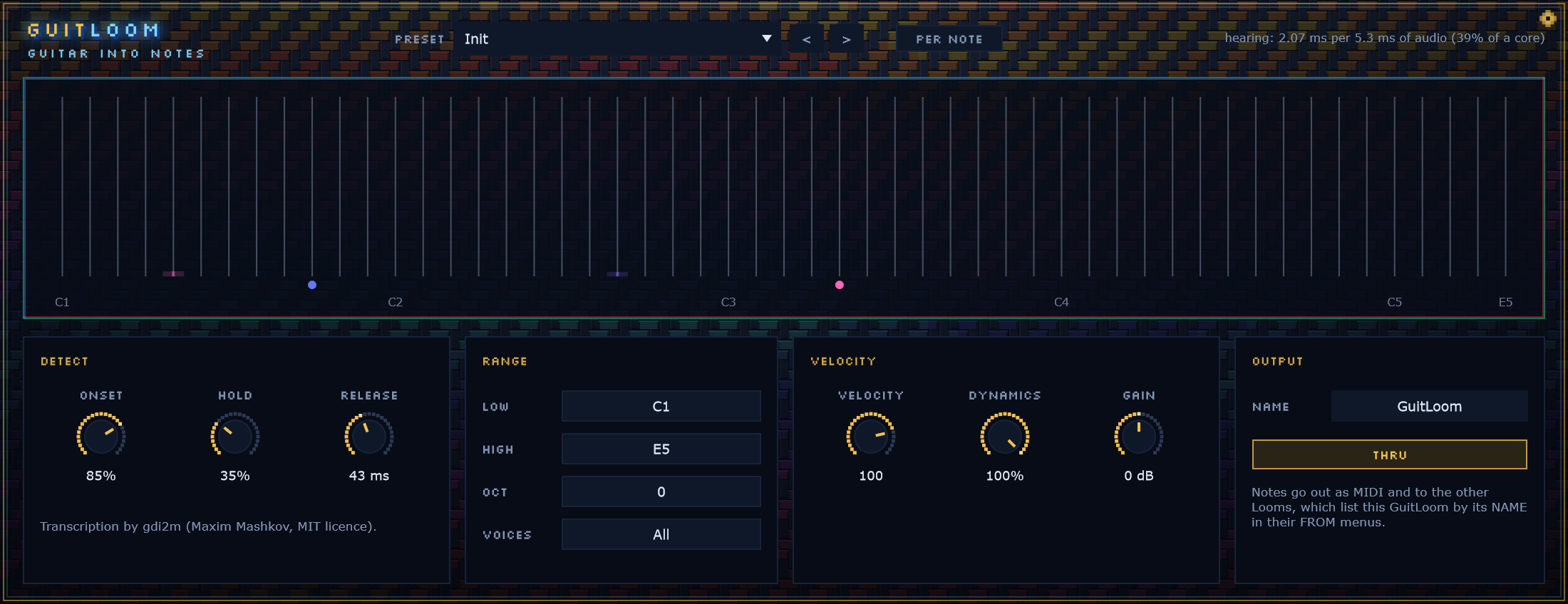
It hears a guitar polyphonically, from C1 to E5, and plays what it hears as notes about 9 ms after the string is struck. The hearing is gdi2m's, a small neural network trained on electric guitar recordings. ONSET, HOLD and RELEASE set how sure it has to be, RANGE keeps it to some strings or limits how many notes sound at once (one turns chords into a line), and velocity follows how hard you play. Each of the twelve notes can be switched off or moved onto a scale. The guitar goes through untouched.

Takes
a guitar, best a clean DI
Offers
the notes it hears, as MIDI and to the Looms
GuitLoom's window: the notes it hears from the guitar, with the note columns below

Times the notes

PENDULOOM

A held triad turns into a polyrhythm.

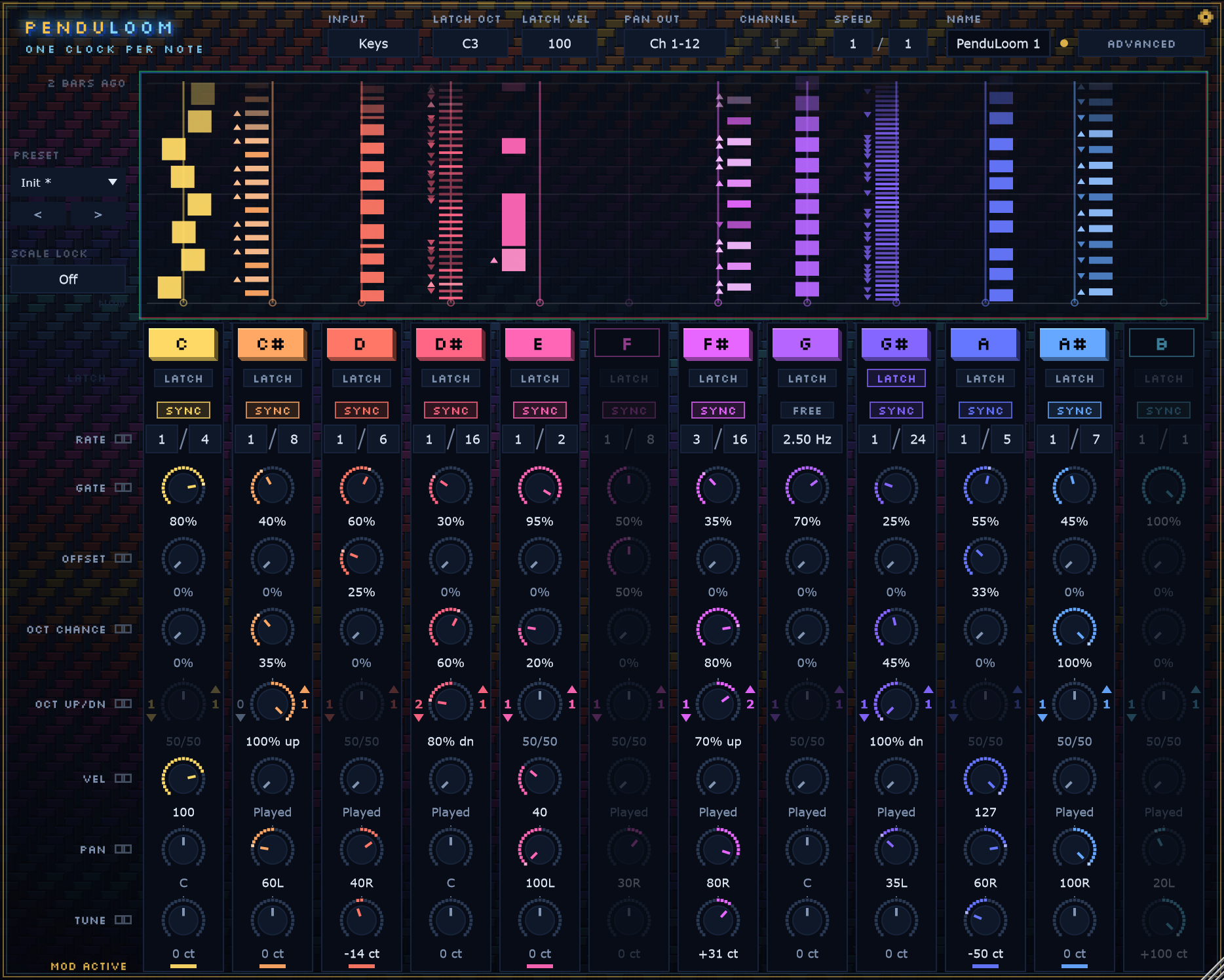
Each of the twelve notes has a clock of its own. Hold a chord and every note pulses at its own rate, gate length and offset. It also has octave jumps, panning, and per-step randomisation of rate, gate, velocity and pan.

Takes
this track's keys
Offers
the notes it pulses
PenduLoom's window: twelve note columns under a view of the notes as they pulse

Picks from the notes

SHLOOM

A held chord turns into a line that chooses its own notes.

It is a sample-and-hold for notes. At a set interval it looks at the notes held, picks some (all, random, lowest, highest, spread, no repeat) and plays those, with octave jumps and a length of its own. LEGATO now and then ties a pick's notes into the next, for an instrument that glides. As a Sender it shares a track's notes; as a Sampler it takes notes from up to eight others; as a Receiver it plays another track's notes as they are, so one keyboard can play an instrument on any track. Most chains are built from SHLooms.

Takes
keys, SHLooms, PenduLooms, ResoLooms
Offers
what it receives (Sender) or plays (Sampler)
SHLoom's window: incoming notes, sample lines and played notes over a C0 to C6 range

Turns notes into grains

GRANULOOM

Every note it is given becomes grains of a sample, overlapping into a pad.

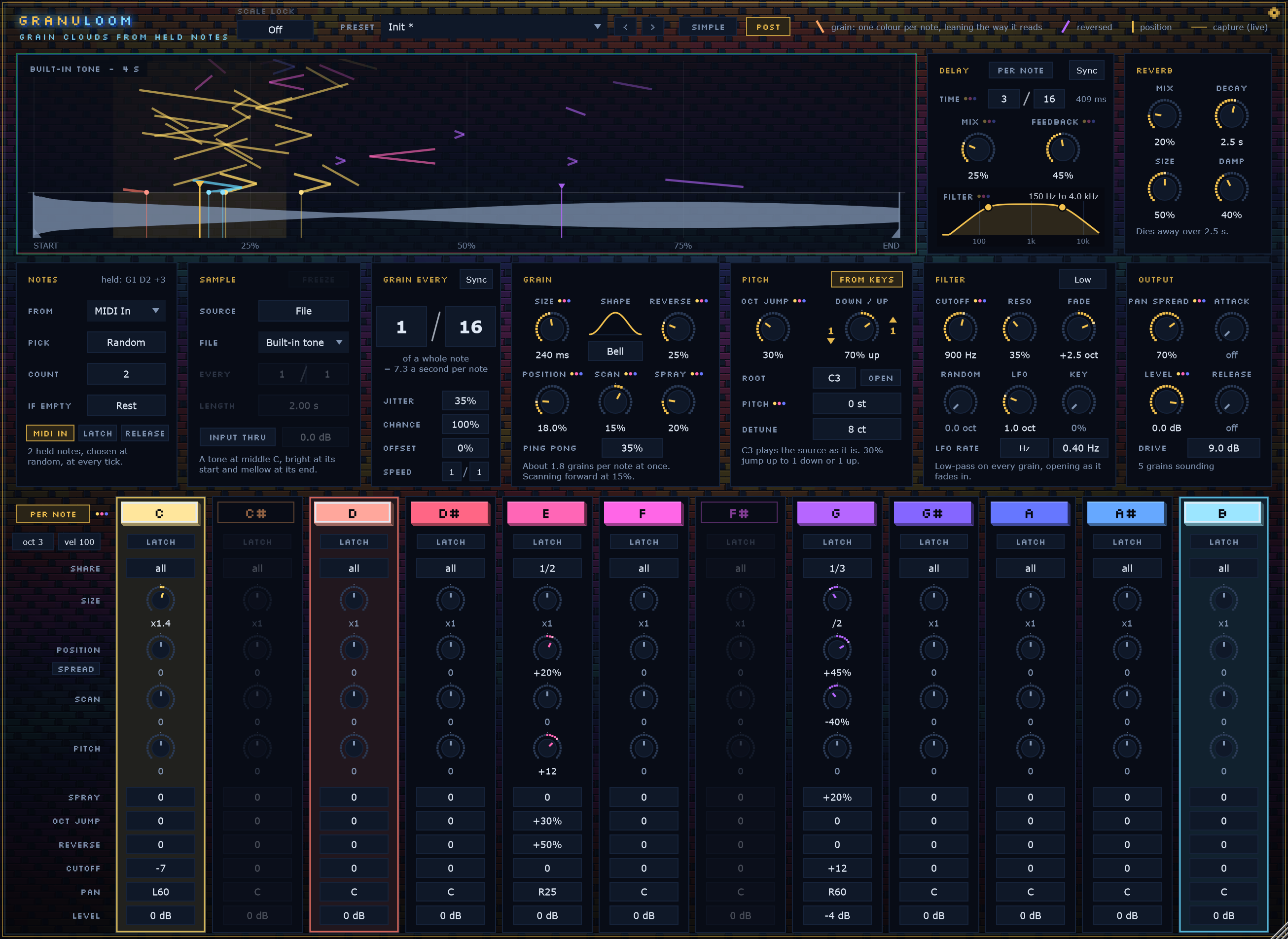
It is a granular synth. At each tick it plays one grain for each note it picks. Each of the twelve notes can have its own share of grains, size, place in the sample, pitch, filter, pan and direction. A drive, from gentle saturation to hard distortion, bends each note on its own so a chord stays a chord, and a delay and a reverb follow. It can also capture its audio input as the sample, and its SIMPLE mode makes it a plain granular synth.

Takes
keys, SHLooms, PenduLooms, ResoLooms
Offers
sound only, so it ends a chain
GranuLoom's window: grains drawn as threads over the source sample, with note columns below

Turns audio into strings, and strings into notes

RESOLOOM

Audio sets 61 strings ringing, and the strings that ring come out as notes.

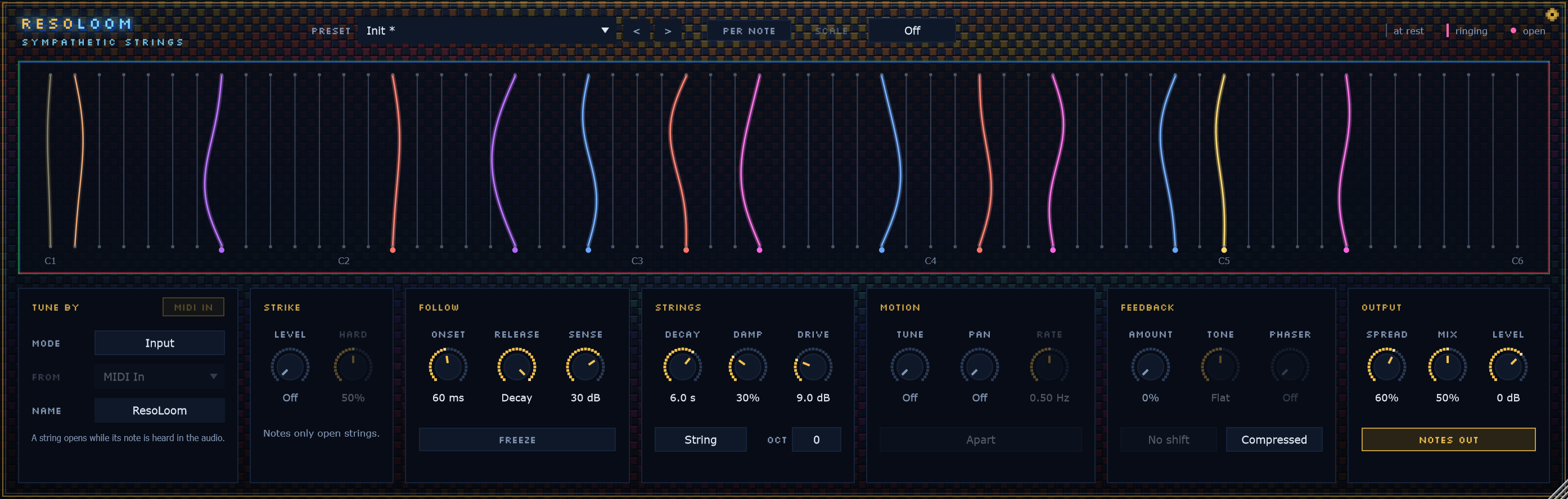
Because it sends its open strings to the other Looms, a drum loop or a voice can play a chain with no keyboard on any track. Strings open by the audio itself, by held notes, by both, or always, and can be strings, pipes, forks, bars, bells or skins. Feedback lets them set each other off, shifted by a fourth, fifth or octave, MOTION drifts their tuning and pan, and DRIVE saturates each note on its own. ResoLoomSynth is the same plugin built as an instrument.

Takes
audio, keys, SHLooms, PenduLooms, ResoLooms
Offers
sound, and its open strings as notes
ResoLoom's window: 61 strings from C1 to C6 with their gates and the note columns

Loops what it hears, at the speed of each key

HEIRLOOM

A chord becomes one moment of audio at several speeds at once.

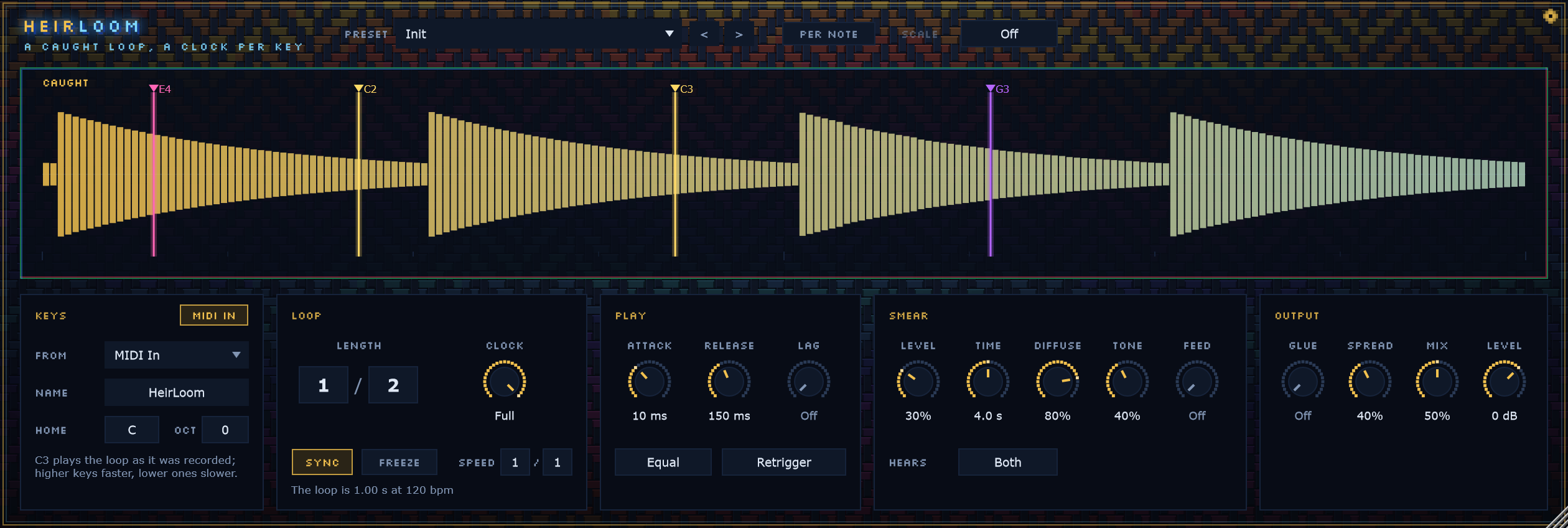
It is a short looper that listens all the time. Hold a key and it catches the last stretch of audio as a loop, and every held key plays that loop at its own speed: the home key as recorded, a fifth above half as fast again, an octave below at half speed. CLOCK roughens the low keys more than the high ones, and a smear, a diffuse echo, can be written back into the loop until it dissolves. Each of the twelve notes has its own level, part of the loop, direction and pan. It started from the micro-looper of the Chase Bliss Mood pedals.

Takes
audio, keys, and notes from the other Looms
Offers
sound only, so it ends a chain
HeirLoom's window: the caught loop, with the note columns below

CHAINS TO START WITH

Each line down is a ticked source in FROM, or one drag in MasterLoom.

Bass and pad from one progression

Wire a CompLoom to two Looms and light different slots on each wire. A Sampler takes only slot 1 and plays the bass line in eighths, and GranuLoom takes the middle of every card as a pad. When the card changes, both move with it.

Drums in key

Set a CompLoom's scale to This card and ResoLoom's SCALE LOCK to Nearest. Only the strings of the chord in use can ring, so a drum loop plays the progression, and GranuLoom turns what rings into grains.

Audio becomes notes

The strings that a drum loop sets ringing come out of ResoLoom as notes. A Sampler keeps the lowest one each beat, and that becomes the bass line of a grain pad, with no keyboard on any track.

Chords to grains

Play chords on the piano track as usual. A Sampler on another track picks three notes from them every three sixteenths, and GranuLoom turns each pick into a burst of grains.

Polyrhythm on strings

Hold a chord into PenduLoom and let each note keep its own time. ResoLoom takes the pulses and strikes the matching strings, which ring into each other through the feedback.

Two hands, one sampler

Tick two Senders in one Sampler's FROM and their notes merge. A second Sampler takes the top note of each pick and moves it up an octave, which gives an arpeggio drawn from both parts.

Guitar to grains

GuitLoom turns what you play into a single line, a Sampler takes its top note and lifts it an octave now and then, and GranuLoom plays grains at those notes under the guitar.

A voice that follows the chords

Put HeirLoom on a vocal track and tick a CompLoom in its FROM. The card's notes are its keys, so it catches a moment of the voice and plays it as the chord, at several speeds at once, moving with the progression.

GET THEM

Status

All eight build for Windows as VST3 and CLAP and pass their automated checks, which drive the engines and measure what comes out. They have not yet been tried inside a host, GuitLoom has not yet heard a real guitar, and there is no release yet. There are no builds for other systems.

Formats

VST3CLAP
PenduLoominstrument, silentnote effect
SHLoomeffect, audio passesnote effect
GranuLoominstrumentinstrument
ResoLoomeffectaudio effect
ResoLoomSynthinstrumentinstrument
HeirLoomeffectaudio effect
CompLoominstrument, silentnote effect
GuitLoomeffect, audio passesaudio effect
MasterLoomeffect, audio passesaudio effect

Source and guide

Building from source takes Visual Studio 2022 and one script. To hear when the first release is out, watch the repository on GitHub.

Source on GitHub

User guide